NASA Is Blasting Fake Moon Dirt to Make Real Landings Safer
Published September 10, 2026
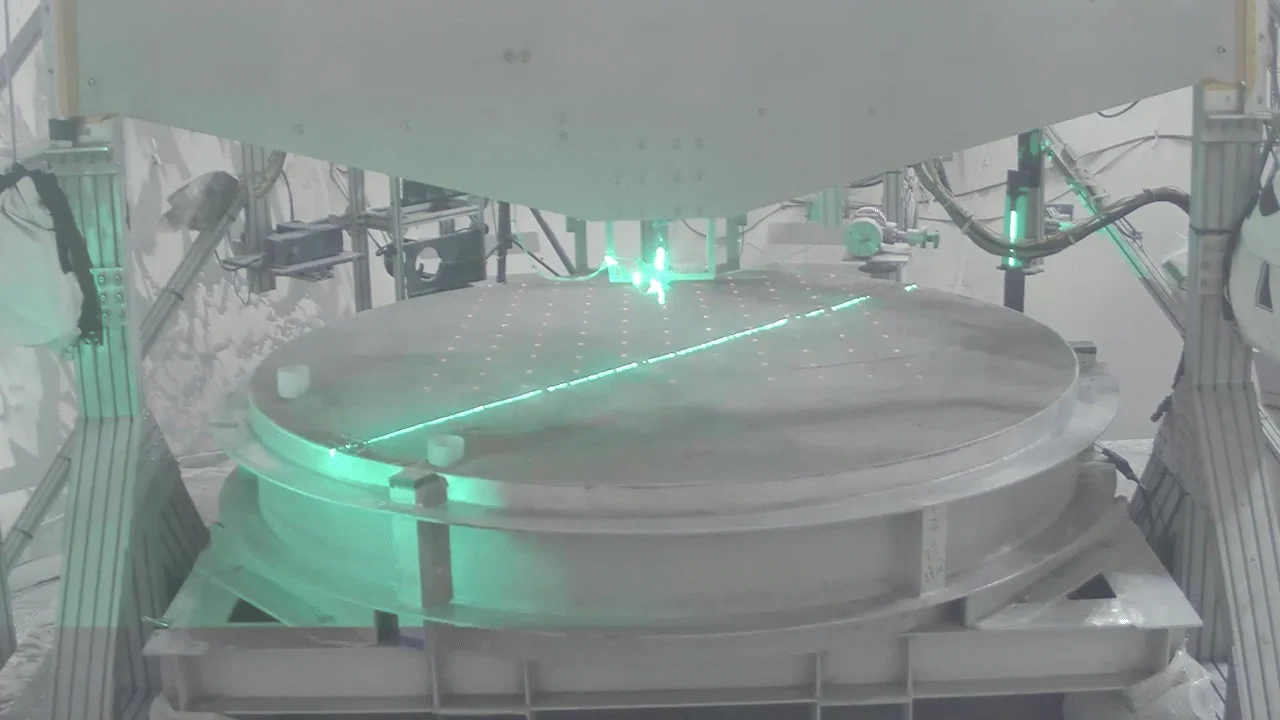
Inside a 60-foot vacuum sphere, NASA is measuring how landing-engine plumes throw lunar soil. The six-second tests target a serious landing hazard.
Touching down is not the end of a lunar lander's interaction with the ground. Its engine exhaust can excavate the surface and fling material toward the vehicle and nearby equipment. NASA is tackling that problem with a decidedly physical experiment: fire a plume into simulated Moon dirt and measure what moves.
Six Seconds of Useful Mess
In an August 26 update, NASA described tests in a 60-foot spherical vacuum chamber at Langley. A heated, non-burning ethane system fires into a bin of Black Point-1 regolith simulant. Instruments track crater formation, the shape of the ejecta sheet, and particle motion during runs lasting about six seconds.
NASA Langley operates that plume system. The source corrected this point on September 2; Purdue built it, while NASA Stennis designed it. The campaign also plans a separate small hybrid rocket motor for a later phase, rather than treating one plume source as a stand-in for every engine.
The image above is a frame from an actual chamber test. It is not footage of a spacecraft landing on the Moon.
Why Not Just Trust the Simulation?
A simulation is most useful when there is a way to challenge it. Engineers can vary an input and watch a virtual result change, but that does not establish that the model represents the relevant physics accurately. A controlled experiment gives the prediction something independent to answer to.
This is the appeal of the chamber approach. The team can observe a difficult interaction while controlling important conditions and placing instruments where they would be awkward to install during a real landing. That does not erase the differences between a ground test and a mission. It makes those differences part of an explicit engineering problem.
For small workshop experiments, the same principle applies. A convincing render of airflow, heat, or mechanical stress is not a measurement. Before leaning on it, ask what observation could show that the model is wrong. If no result could change your confidence, you may be admiring an illustration rather than testing an explanation.
Measure More Than the Hole
The obvious result of blowing material away is the depression left behind. The less obvious question is where the material went. A design can look acceptable at the point of contact while causing trouble somewhere else.
That is a useful way to think about system boundaries. Does your test measure only the part you intended to affect, or also the parts that receive the consequences? It is relevant to dust extraction, cooling fans, spray processes, and any prototype that moves material through its surroundings.
Our takeaway: the messy side effect deserves its own instruments. Six seconds can produce a great deal of evidence when the experiment is built around the right questions.
What overlooked side effect has changed one of your builds? Share it in the comments below.
Comments
Member comments are temporarily unavailable.
Log in to join the discussion.