A Cold War Uranium Site Could Become a $100 Billion AI Campus
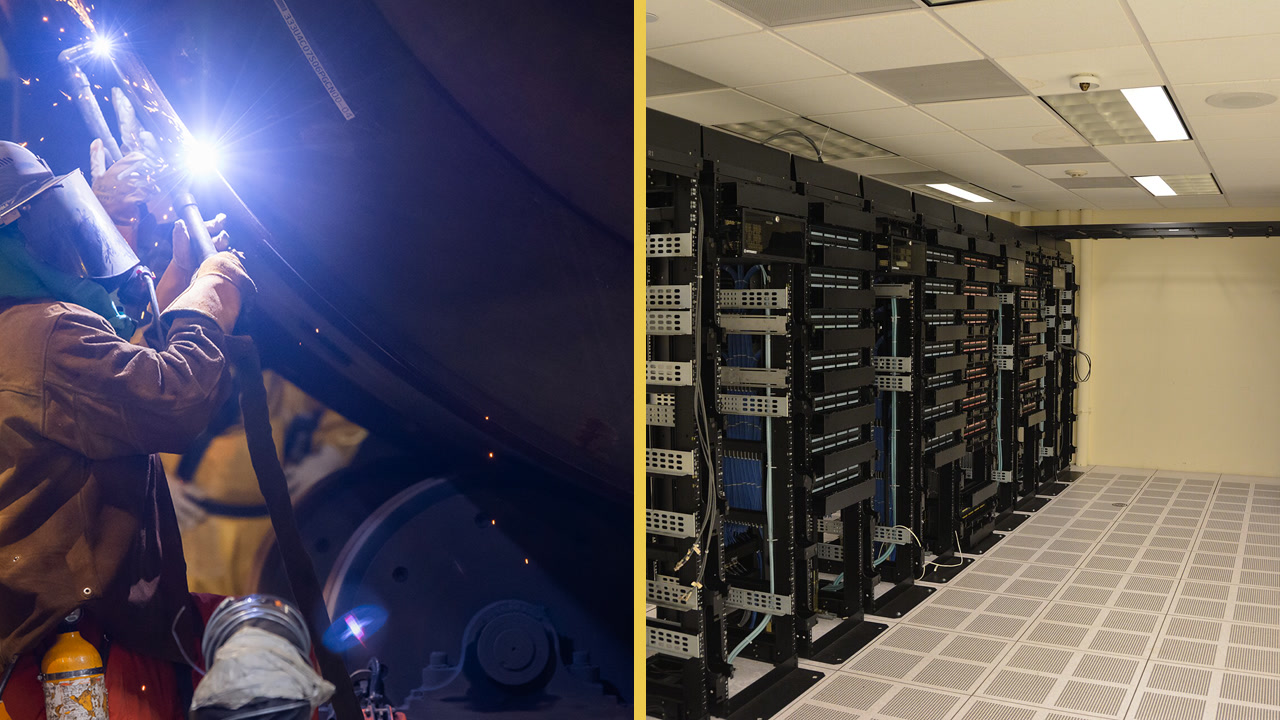
A proposed Kentucky AI campus pairs 1.8 gigawatts of computing with new gas generation and battery storage at a former uranium-enrichment site.
A Kentucky complex built to enrich uranium during the Cold War could become one of the clearest examples yet of what the AI boom physically demands: land, fiber, water, power plants, batteries, transmission lines, and an almost unbelievable amount of money.
On July 29, the U.S. Department of Energy announced a partnership to develop an AI and high-performance-computing campus at its Paducah Site. The proposal carries a headline figure above $100 billion, but it is not simply a very large server farm. Its energy system is being planned at the same time and at nearly the same scale.
The proposal is measured in gigawatts
The DOE announcement calls for a 1.8-gigawatt AI and high-performance-computing campus. NextEra Energy plans to build 2 gigawatts of grid-connected natural-gas generation, upgrade transmission infrastructure, and add as much as 2.6 gigawatts of battery storage at or near the site.
Brookfield was selected to develop and operate the data-center campus. Big Rivers Electric Power Corporation, Jackson Purchase Energy Cooperative, and Paducah Power System are also named as partners. DOE says the private investment is expected to create about 8,000 construction jobs and 600 permanent jobs, with construction targeted for completion in 2031.
The agency says generation and storage would exceed the campus's needs so surplus electricity could flow to the regional grid. That is the central promise of the arrangement: the computing load would arrive with new power rather than simply taking a giant bite out of existing supply.
Why build at a former enrichment plant?
The old Paducah Gaseous Diffusion Plant already has several things a giant computing project needs. DOE points to transmission capacity, water infrastructure, fiber connectivity, federal land, and room for redevelopment.
Those assets exist because the site once performed a different energy-intensive job. Gaseous diffusion separated uranium isotopes for national-security and commercial nuclear uses. The plant stopped enriching uranium in 2013, but environmental cleanup and decommissioning continue across the roughly 3,550-acre property.
That history makes the project more than a real-estate deal. Infrastructure built for one era of strategic technology is being repurposed for another. The same location that once consumed enormous amounts of electricity to process nuclear material could now feed electricity into rows of AI accelerators.
The difficult questions sit outside the server racks
The proposal is not fully settled. DOE says the power-service agreement still requires approval from the Kentucky Public Service Commission. The Associated Press also reported that discussions with potential computing customers were ongoing when the project was announced.
The AP identified other points that will need scrutiny. The planned gas generation would be the largest gas-fired power plant in Kentucky. Local and environmental advocates have raised questions about emissions, water, construction on a contaminated federal site, and whether ordinary utility customers could end up subsidizing transmission or generation upgrades.
Those are not side issues. A 1.8-gigawatt computing campus is an energy and land-use project that happens to contain computers. Its public impact will be shaped as much by utility regulation, cleanup work, water management, and power contracts as by whatever models eventually run inside it.
AI infrastructure has become the AI story
The Paducah plan shows why coverage of artificial intelligence can no longer stop at model releases and benchmark scores. Training and serving large systems creates demand that reaches backward through chips, cooling equipment, substations, pipelines, generators, and battery fields.
DOE presents the project as a way to pair that demand with new generation, jobs, and redevelopment. Critics see a need for careful permitting and protection against shifting costs or environmental risk onto the surrounding community. Both sides are talking about the same underlying fact: AI has become a physical industry.
The $100 billion figure may draw the click, but the more durable number is 1.8 gigawatts. It is a reminder that the next phase of computing will be built not only in code repositories, but on power grids.
Comments
Member comments are temporarily unavailable.
Log in to join the discussion.