Roman Has Launched. Its Biggest Trick Is Seeing More Sky at Once
Published September 10, 2026
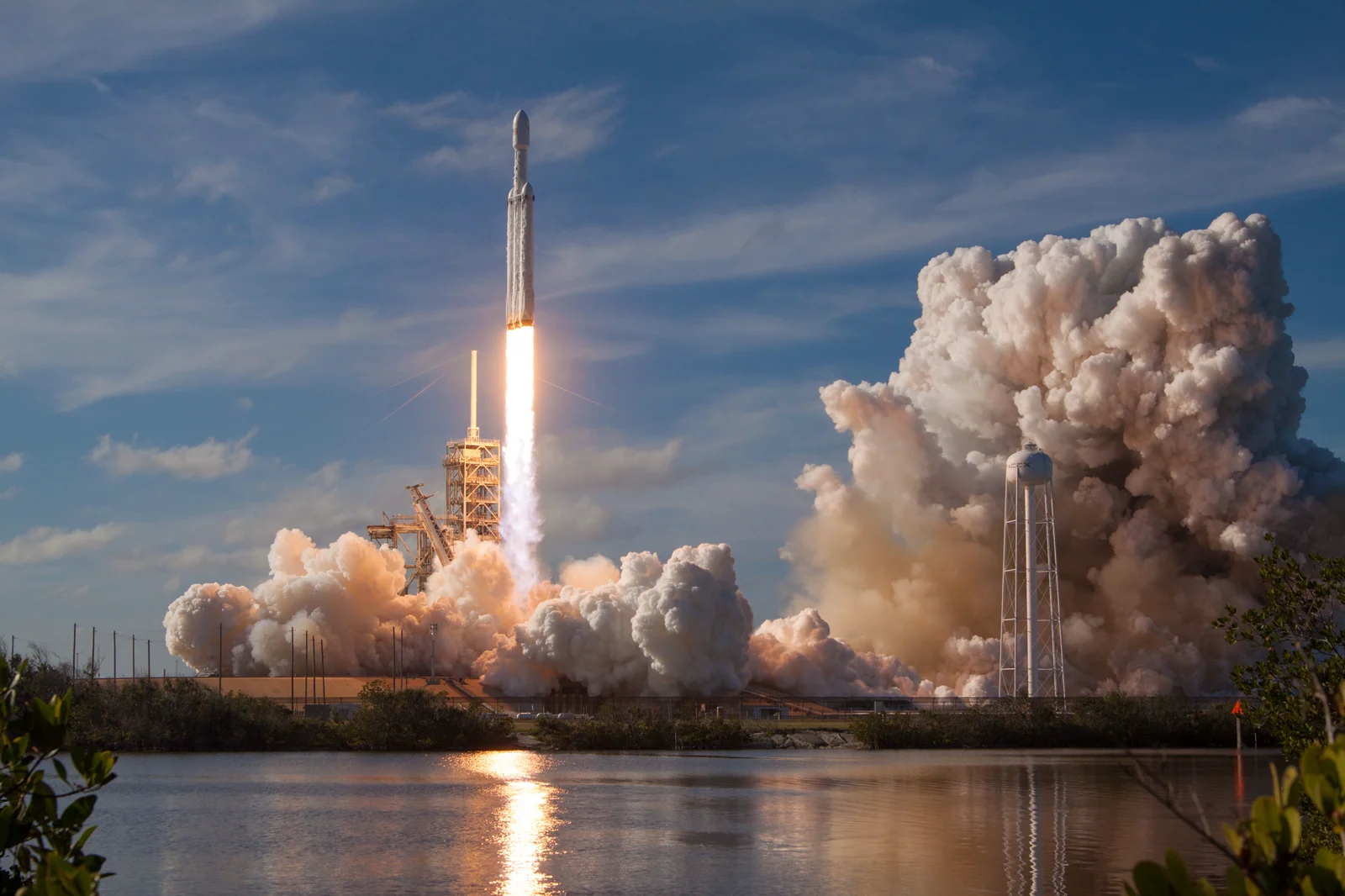
Falcon Heavy's 2018 demonstration flight, an archival view of the launcher type used for Roman.
NASA's Roman telescope launched on August 30. Its wide-field camera turns Hubble-like detail into a survey machine, with commissioning still ahead.
The Nancy Grace Roman Space Telescope is no longer waiting for its ride. NASA's new observatory launched aboard a Falcon Heavy on August 30, beginning a mission designed to change the scale at which astronomers survey the universe.
That is a different promise from simply taking a sharper picture. Roman's appeal is the combination of detail and coverage: fewer tiny windows, much more sky.
Launch Is the Beginning, Not First Light
NASA's launch report places liftoff at 7:26 a.m. EDT from Kennedy Space Center's Launch Complex 39A. The spacecraft separated successfully and began its journey toward an orbit around the Sun-Earth L2 region, roughly a million miles from Earth.
Deployment, travel, and commissioning come before routine observing. NASA's launch-day expectation was for the first images in early 2027. That schedule is an expectation, not a claim that Roman has already produced its planned science results.
The distinction matters whenever a major instrument launches. Getting the hardware into space clears a formidable obstacle, but calibration is what turns hardware into a trustworthy measuring system.
A Bigger Camera Changes the Experiment
Roman's Wide Field Instrument is a roughly 300-megapixel camera built from an array of detectors. NASA's instrument overview explains its large field of view; the agency's Hubble comparison describes similar angular resolution across a much larger patch of sky.
Field of view and magnification are not interchangeable. A camera that records more of a scene in each exposure does not automatically enlarge each object more. What it can do is collect comparable measurements of many more objects with fewer pointings.
For survey science, that changes the practical question from which single target deserves attention to which patterns emerge across a population. It also changes the engineering workload. A larger stream of images needs dependable calibration, storage, processing, and ways to identify the interesting exceptions without losing the context around them.
The Maker Connection Is the Whole System
There is a familiar trap in camera projects: optimize the sensor specification and leave the rest for later. Then the enclosure flexes, the exposure timing wanders, or the data transfer cannot keep up. A headline number is not a complete instrument.
Roman is a useful reminder to think in chains. What arrives at the detector? What changes during measurement? What must be stored alongside the image so someone else can interpret it? Which repeated checks tell you that two pictures are genuinely comparable?
Our interest is in that connection between ambitious science and unglamorous consistency. The mission's launch is new; the engineering lesson will remain relevant long after launch-week excitement fades.
Which part of a wide-field imaging project would you tackle first: optics, detector calibration, or the data pipeline? Tell us in the comments below.
Comments
Member comments are temporarily unavailable.
Log in to join the discussion.