NASA's Roman Telescope Is Fueled, Mounted, and Almost Ready to Fly
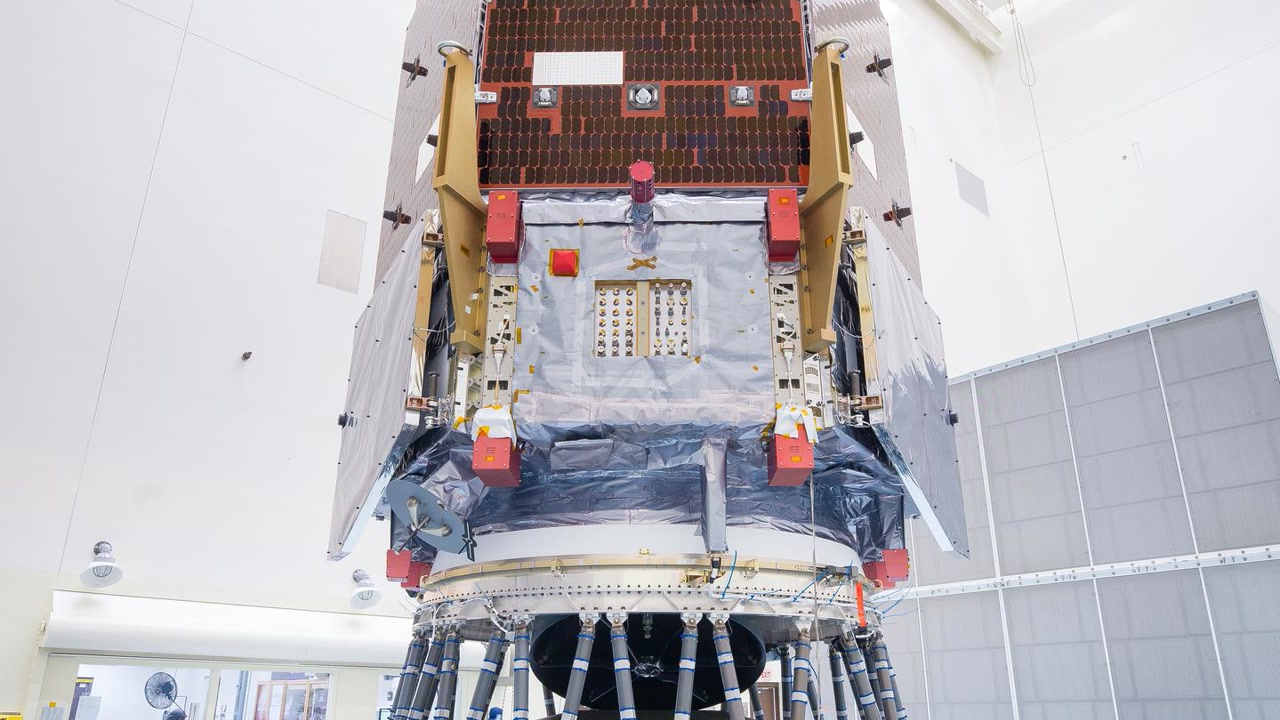
Photo credit
NASA has fueled the Roman Space Telescope and mounted it to SpaceX launch hardware ahead of a no-earlier-than August 30 Falcon Heavy flight.
NASA's next flagship space telescope has moved out of the "someday" phase and into the part where technicians load hazardous fuel, bolt the observatory to flight hardware, and prepare to hide years of engineering inside a rocket fairing.
The Nancy Grace Roman Space Telescope is now fueled and attached to the hardware that will connect it to a SpaceX Falcon Heavy. NASA is targeting launch no earlier than August 30, 2026, nine months ahead of the mission's previous schedule.
Roman is meeting its rocket one layer at a time
On August 10, NASA said teams at Kennedy Space Center had mated Roman to its payload adapter and lifted the observatory onto a strut payload attach fitting. That structure is designed to carry the large spacecraft and secure it to the rocket's second stage.
The next major step is encapsulation. Technicians will enclose Roman inside the Falcon Heavy payload fairing, the aerodynamic shell that protects a spacecraft from heat, pressure, and airflow during ascent. The enclosed payload will then move to SpaceX's hangar at Launch Complex 39A for integration with the rocket.
This is less glamorous than a first image from space, but it is where a telescope becomes a launch payload. Mechanical interfaces, electrical connections, clearances, contamination controls, and handling procedures all have to work together before the rocket ever reaches the pad.
The fuel is for a million-mile trip
The integration update follows a hazardous operation completed on July 25. NASA reported that technicians loaded 290 gallons of hydrazine into the observatory at Kennedy's Payload Hazardous Servicing Facility.
Roman will use that propellant after separating from Falcon Heavy. Its destination is Sun-Earth Lagrange point 2, or L2, roughly one million miles from Earth. The observatory's thrusters will help it travel there, maintain its planned orbit, and keep its solar arrays pointed toward the Sun.
NASA says Roman carries enough fuel for its five-year primary mission and potentially another five years of extended operation. That reserve matters because no servicing mission is planned. Once the telescope leaves Earth, every correction and station-keeping maneuver draws from a finite supply.
A wide-field telescope for dark questions
Roman is built to survey large areas of sky with the sharpness expected from a major space observatory. Its science program is aimed at dark energy, dark matter, the growth of galaxies, and planets beyond the solar system.
The wide-field approach is the important distinction. A telescope can produce exquisite detail while still seeing only a small patch at once. Roman is designed to combine detail with broad surveys, letting researchers map huge populations of galaxies and monitor crowded star fields for the temporary brightening caused by gravitational microlensing.
NASA expects the mission to discover thousands of exoplanets. Those detections will not all look like familiar planetary portraits; many will appear as brief changes in the light of distant stars. Repeated, wide observations turn those small signals into a census.
The date is a target, not an accomplished launch
NASA and SpaceX are aiming for liftoff no earlier than 7:26 a.m. EDT on Sunday, August 30 from Launch Complex 39A. "No earlier than" is the important phrase. Final integration, spacecraft readiness, the rocket, range availability, and weather can all move a launch date.
For now, the verified milestone is substantial enough: Roman has its fuel and its first pieces of SpaceX hardware. If the remaining steps hold, the telescope will soon trade a white room in Florida for a million-mile journey and a much wider view of the universe.
Comments
Member comments are temporarily unavailable.
Log in to join the discussion.