The World's Biggest Camera Just Started a 10-Year Movie of the Universe
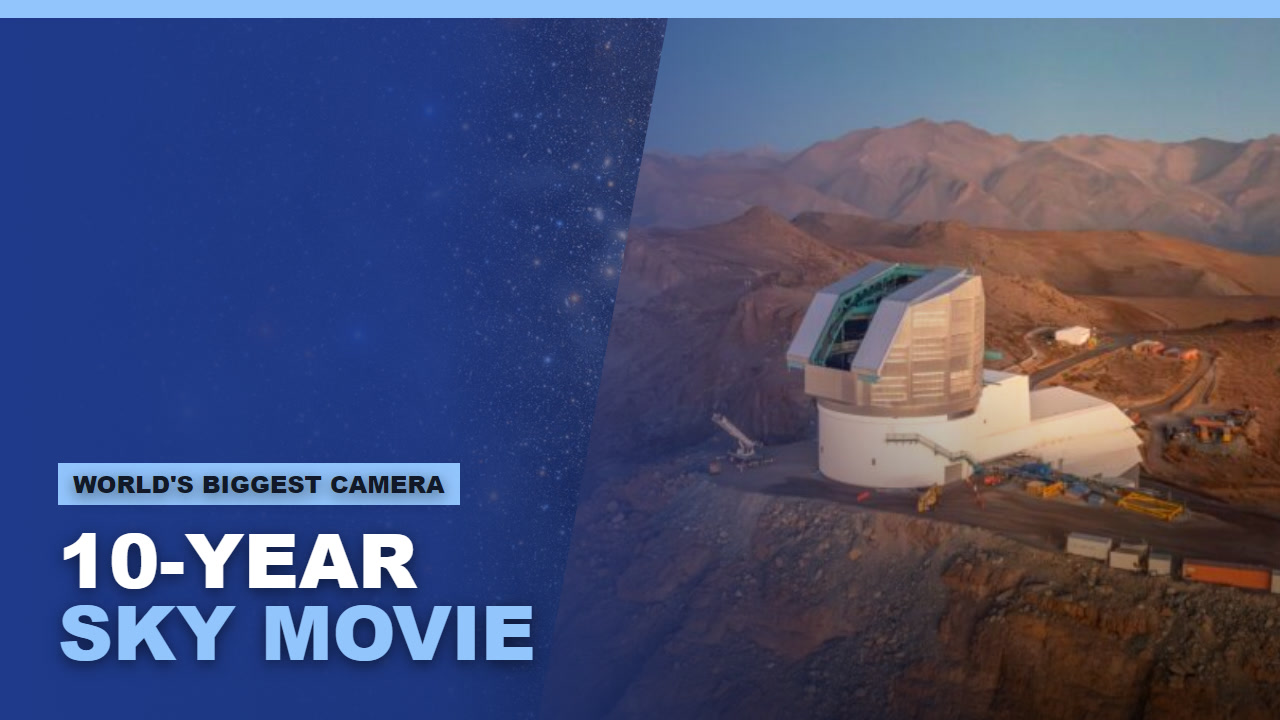
Vera C. Rubin Observatory has begun the LSST, using its 3,200-megapixel camera to photograph the southern sky every few nights for a decade.
The largest digital camera ever built is no longer waiting for first light, commissioning, or one more readiness review. On June 30, 2026, Vera C. Rubin Observatory officially began the Legacy Survey of Space and Time, a ten-year campaign designed to turn the changing southern sky into something astronomers can study like a movie.
That description is not only a metaphor. Rubin will return to the same regions of sky again and again, recording motion, flashes, fading objects, and slow changes that a conventional static sky map can miss. The project combines an enormous camera, a telescope built to move quickly, and a data system intended to tell scientists what changed while there is still time to react.
A camera built for a moving universe
Rubin's 3,200-megapixel camera captures a new image about every 40 seconds. The observatory expects to take roughly one thousand images per night and revisit each part of its survey area about 800 times over the full decade.
That repeated coverage changes the job. Rubin is not simply collecting prettier views of known objects. It is looking for differences between one exposure and the next: a supernova beginning to brighten, an asteroid sliding against the background stars, a black hole feeding unpredictably, or an event no one knew to ask for.
The observatory says it will scan the entire southern sky every few nights. At that cadence, rare events become part of a continuous record instead of isolated discoveries that happened to be caught by a telescope pointed in the right direction.
The alert stream is part of the instrument
The camera is only the visible end of Rubin. Each night is expected to produce about ten terabytes of data and as many as seven million alerts describing changes in the sky. Automated brokers will sort those alerts so research teams can decide which events deserve immediate follow-up from other telescopes.
That makes the software pipeline as important as the mirror and camera. A fleeting cosmic event may be scientifically valuable for minutes or hours. Detecting it after the night's observations are archived is not enough. Rubin has to compare images, distinguish real changes from artifacts, package the result, and send it outward at machine speed.
The scale is already producing results. Rubin reported that early optimization surveys found more than 11,000 previously unseen asteroids in about a month and a half, including 33 near-Earth objects and 380 objects beyond Neptune.
Why ten years matters
Some of Rubin's targets change in seconds. Others reveal themselves only through patterns measured over years. The survey is designed to serve both timescales.
Repeated measurements will help astronomers build a more complete census of asteroids and comets, trace how stars vary, study the history of galaxies, and investigate dark matter and dark energy. When the LSST ends, Rubin expects its final data set to contain billions of objects and trillions of measurements.
The most exciting part is that no list of goals can fully predict what a survey like this will find. New instruments often become discovery machines precisely because they make a neglected dimension observable. Rubin's dimension is time at enormous scale: the sky is no longer a picture but a system in motion.
A new kind of public observatory
Rubin says its regular data releases will make this record available to scientists and invite the public to explore it as well. That broad access matters because the alert volume is far beyond what one institution could investigate alone.
After two decades of engineering, the defining achievement is not one first image. It is a repeatable process that can keep watching, comparing, and reporting night after night. The world's biggest camera is rolling, and astronomy now has a ten-year production schedule.
Comments
Member comments are temporarily unavailable.
Log in to join the discussion.