Saturn Has a New Ten-Sided Mystery at Its South Pole
Published September 10, 2026
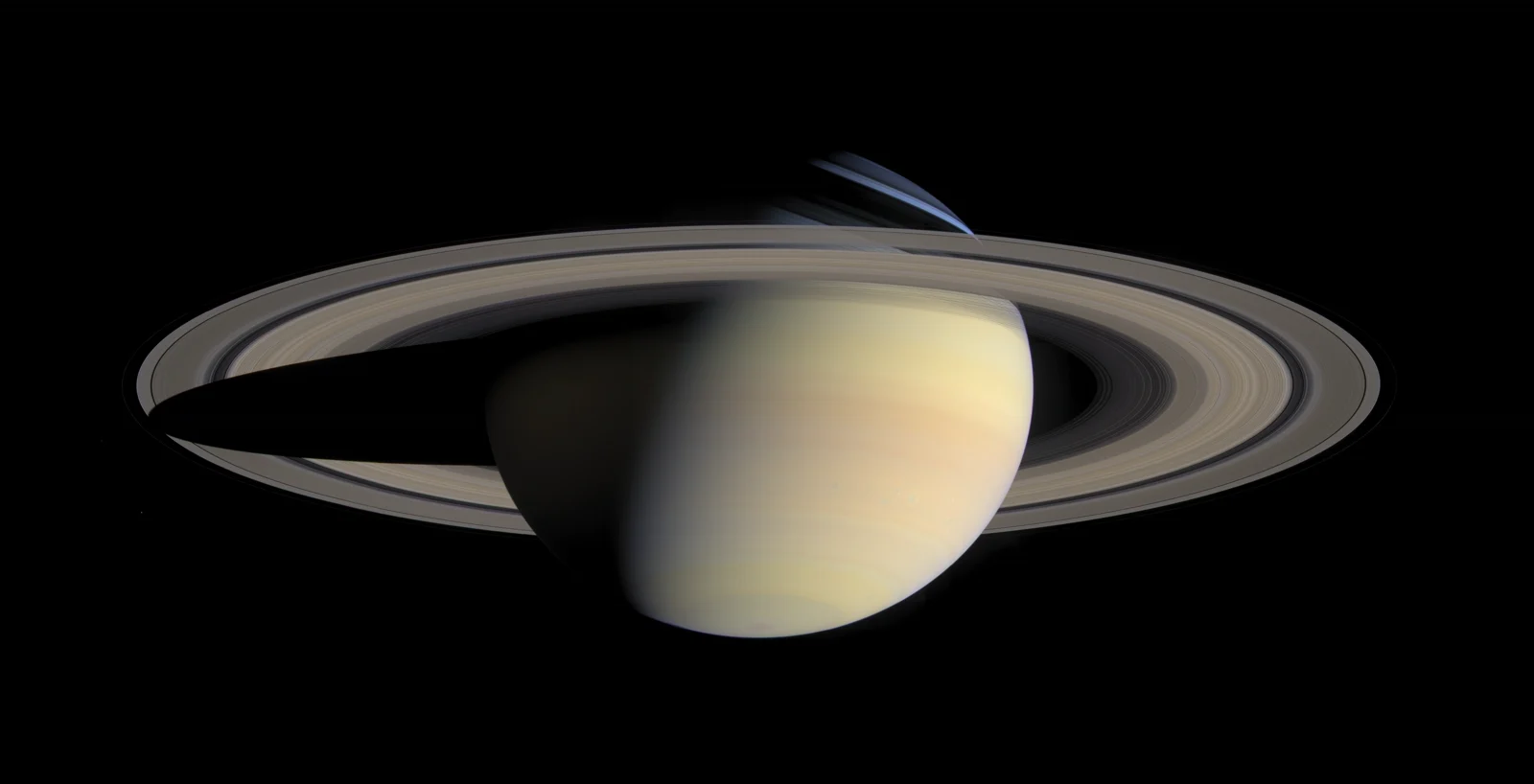
Saturn in a 2004 Cassini view. The newly reported southern wave is shown in the linked Hubble research, not this archival image.
Hubble has tracked a growing ten-sided wave around Saturn's south pole. The surprise is not just its shape, but watching a planetary pattern emerge.
Saturn apparently has room for another polygon. Astronomers have identified a ten-sided atmospheric wave around its south pole, adding a new puzzle to the planet already famous for its northern hexagon. This time, the intriguing part is that the pattern appears to be developing while observers watch.
A Shape With a History
The September 2 ESA/Hubble announcement describes a jet-stream feature visible in Hubble observations reaching back to 2023. Ground-based observers noticed hints in 2024, with stronger evidence in 2025. The changing view of Saturn's southern hemisphere helped bring it into sight.
The wave extends through multiple atmospheric layers. It is not a solid ten-sided object, a structure built on the planet, or evidence of anything artificial. Researchers still need to establish why it emerged and whether it will persist. Saturn's northern hexagon has a decades-long observation record; the southern decagon does not yet have that history.
That distinction makes the discovery more interesting, not less. A pattern with an uncertain future gives researchers something to test: whether their models can explain its development, rather than merely resemble one attractive image.
Why Repeat Photographs Matter
A single photograph can reveal a shape. A sequence can reveal a process. The difference is familiar to anyone who has photographed a growing crystal, logged a room's temperature, or watched a print fail halfway through. The final frame rarely contains the whole explanation.
Here, the valuable instrument is partly the archive itself. Regular observations create a baseline against which an unusual feature can stand out. That does not make every change meaningful. It makes it possible to ask whether an apparent change survives comparisons between dates, viewing angles, and measurement conditions.
For a maker, there is a useful experimental habit to borrow: decide what you will record before you know which result will be exciting. Keep the ordinary runs. Record the settings. Preserve the failures. A folder containing only your most dramatic pictures is a portfolio, but it is a poor substitute for a lab notebook.
The Question Is What Happens Next
Our takeaway is not that Saturn has acquired a permanent matching set of polar shapes. It is that a familiar planet can still supply a new moving target for atmospheric science.
Future observations may show a more stable pattern, further change, or disappearance. Any of those outcomes can be informative if it helps distinguish competing explanations. The attractive image is the invitation; the repeat measurements are the substance.
If you follow planetary imaging, what would you most want compared between the northern and southern patterns: their motion, their vertical structure, or their longevity? Add your reasoning in the comments below.
Comments
Member comments are temporarily unavailable.
Log in to join the discussion.