A cardboard spectroscope and a little library of lamps
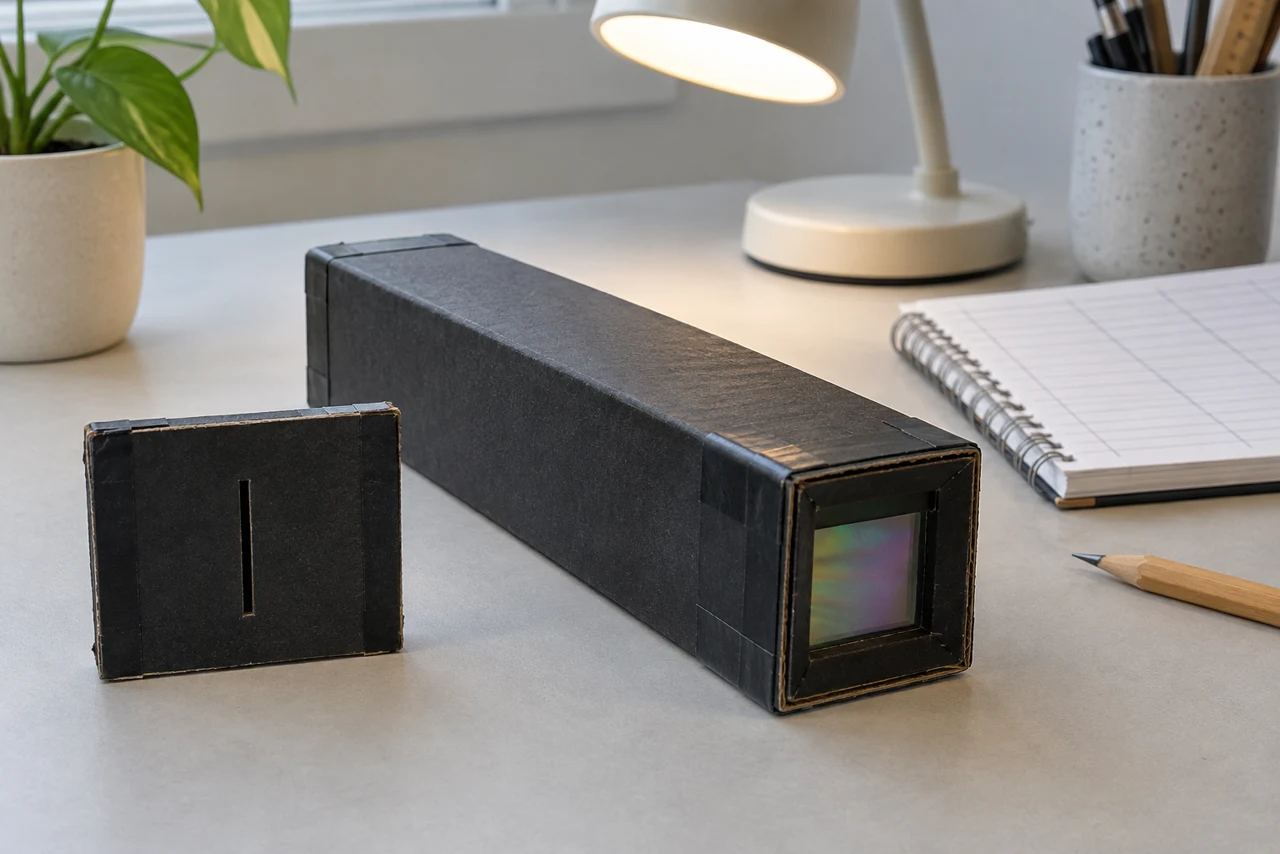
Compare household light sources with a fixed slit and diffraction grating, without pretending an uncalibrated box is a laboratory instrument.
Two lamps can look white and still spread their light very differently. That is a good reason to keep a little library of spectra.
The instrument can be simple: an opaque cardboard body, a narrow entrance slit, and a proper diffraction-grating film in a fixed viewing arrangement. Follow the grating supplier's construction guidance. The box mainly needs to stop stray light and hold the geometry still.
Start with the same view
Pick two ordinary indoor lamps. Keep the distance, slit and viewing position fixed while comparing them. Sketch the broad bands and gaps before trying to turn a phone picture into a measurement.
If a phone joins the experiment, fix its exposure and white balance where possible. Automatic processing can make two identical views appear different. Record the lamp's printed type separately from what the spectrum seems to show.
A cardboard instrument is not automatically a calibrated spectrometer. It is still useful for noticing a difference and asking what causes it.
Do not look at the Sun, lasers or intense light sources through this device. Household lamp comparisons are plenty to begin with.
Materials
- Opaque cardboard box
- Educational diffraction grating
- Fixed narrow slit
- Notebook and optional phone mount
Build Steps
- 1
Fix the geometry
Mount the slit and grating securely using a documented design.
- 2
Compare ordinary lamps
Keep viewing position and camera settings consistent.
- 3
Label the limits
Record qualitative patterns without claiming calibrated wavelengths.