A crystal radio with a tuning log beside it
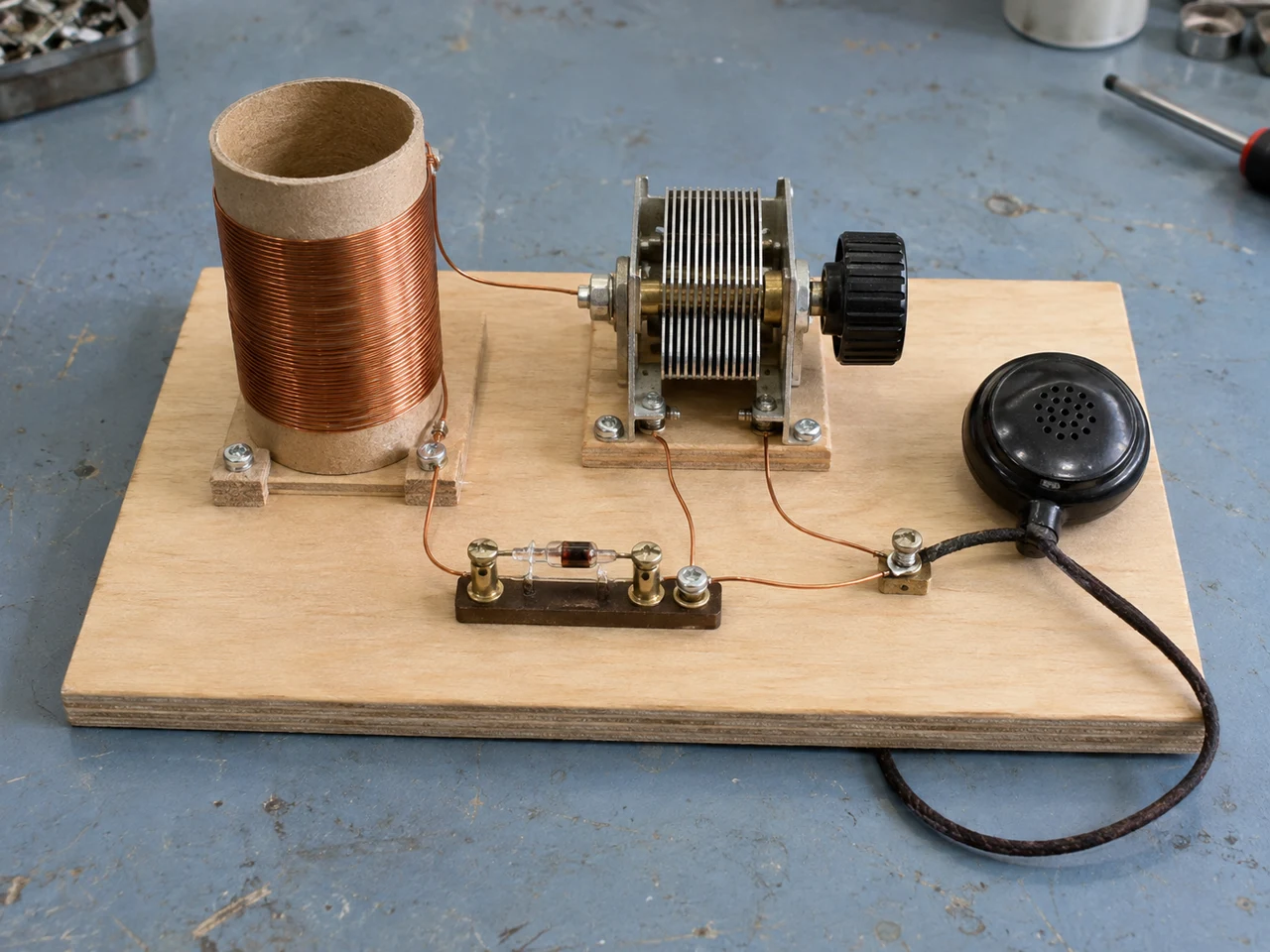
A passive receiver study focused on repeatable tuning adjustments and keeping antenna changes out of the comparison.
There is something appealing about a receiver with no power switch. A crystal set is an exercise in getting a very small signal through a very small number of parts.
Start from a documented receiver design, not from the illustration's wiring. Match the coil, tuning capacitor, detector and high-impedance earpiece to that design. An ordinary low-impedance earbud is not automatically a substitute.
Give tuning a record
Mark a few repeatable knob positions and leave room beside each for a listening note. Keep the antenna arrangement unchanged while comparing them. Otherwise a different room or a moved wire can masquerade as a better tuning adjustment.
Use only a safe indoor antenna arrangement. Do not connect to household mains, plumbing or an improvised earth, and do not put a wire outdoors near power lines or during storms.
The useful first question is modest: does changing the tuning produce a repeatable change? Silence is a reason to inspect connections and component compatibility, not a reason to start adding random power.
Materials
- Documented passive receiver design
- Coil former and insulated wire
- Suitable detector and tuning capacitor
- High-impedance listening device
Build Steps
- 1
Choose a documented circuit
Match component requirements rather than copying the photo.
- 2
Mark the adjustments
Label taps and tuning positions so a setting can be repeated.
- 3
Keep a reception log
Compare one change at a time using a small indoor antenna.