Ten Open-Source Science and Electronics Builds to Explore
Published October 3, 2026
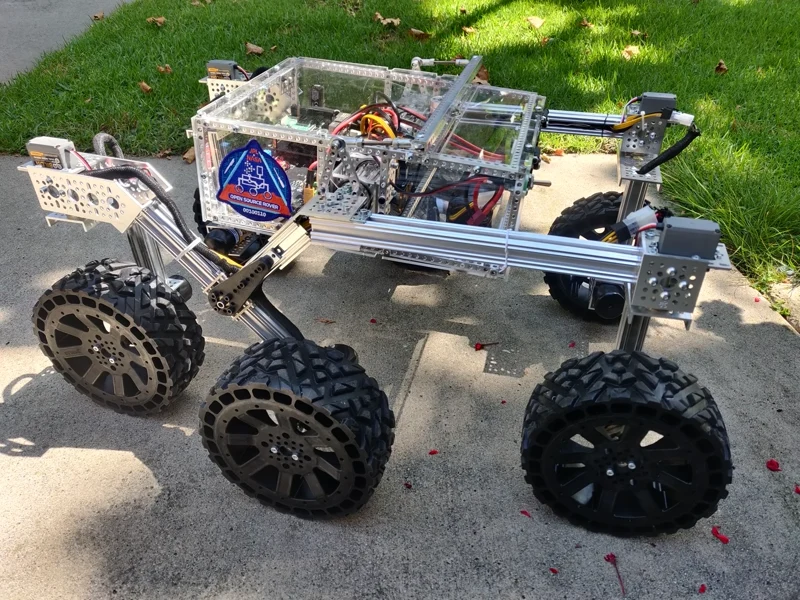
The original Open Source Rover build. Repository photograph, reproduced under Apache-2.0 with creator credit.
Photo credit
images/osr-side-outside.jpg
JPL / California Institute of Technology and Open Source Rover contributors · Apache-2.0Resized without cropping and converted to WebP for the project card.
Choose a LEGO microscope, ESP32 oscilloscope, laboratory syringe pump, haptic dial, DIY e-reader, synthesizer, or JPL rover using complete credited source documentation.
A beautiful finished build is a good reason to look. It is not enough information to order the parts.
The useful questions come next. Where are the assembly instructions? Which readings are measured, and which are estimates? Does the pictured prototype have features that the published firmware actually supports? Will you need a network service, a MIDI instrument, or a machine shop that you do not already have?
These ten projects give you different answers. We have republished their licensed documentation with genuine creator credits, original photographs and figures, source revisions, and permission notices. For the bigger builds, that includes the assembly chapters and original PDF manuals, not just an introduction. This guide is an original comparison; the project instructions and reported results belong to their credited creators, not to independent testing by this site.
Choose the Experiment First
| If you want to explore... | Open this build | The detail to check before committing |
|---|---|---|
| Motorized imaging and optics | MicroscoPy LEGO microscope | The assembly PDF, camera compatibility, and six motorized axes |
| Sampling a low-voltage signal | ESP32 browser oscilloscope | Input limits and the author's sampling-rate caveats |
| Benchtop fluid handling | Ender 3 syringe pumps | Assembly, operation, and characterization are separate documents |
| MQTT and environmental displays | E-paper weather receiver | Forecasts come from elsewhere; equivalent CO2 is not directly measured CO2 |
| Programmable tactile feedback | SmartKnob | Advanced soldering and a tested hardware revision |
| Embedded book rendering | ESP32 ePub reader | Compatible e-paper hardware, PSRAM, and storage |
| Spatial sound and networking | Alles mesh synthesizer | Synchronization and network reliability, not instant response |
| Touch-sensitive instruments | Diapasonix | An early prototype without a step-by-step assembly manual |
| A physical synth control panel | MiniTeensy | Version-specific pin assignments and the audio path |
| Mechanical robotics | JPL Open Source Rover | A substantial parts list and time commitment |
A Microscope Is Several Problems Working Together
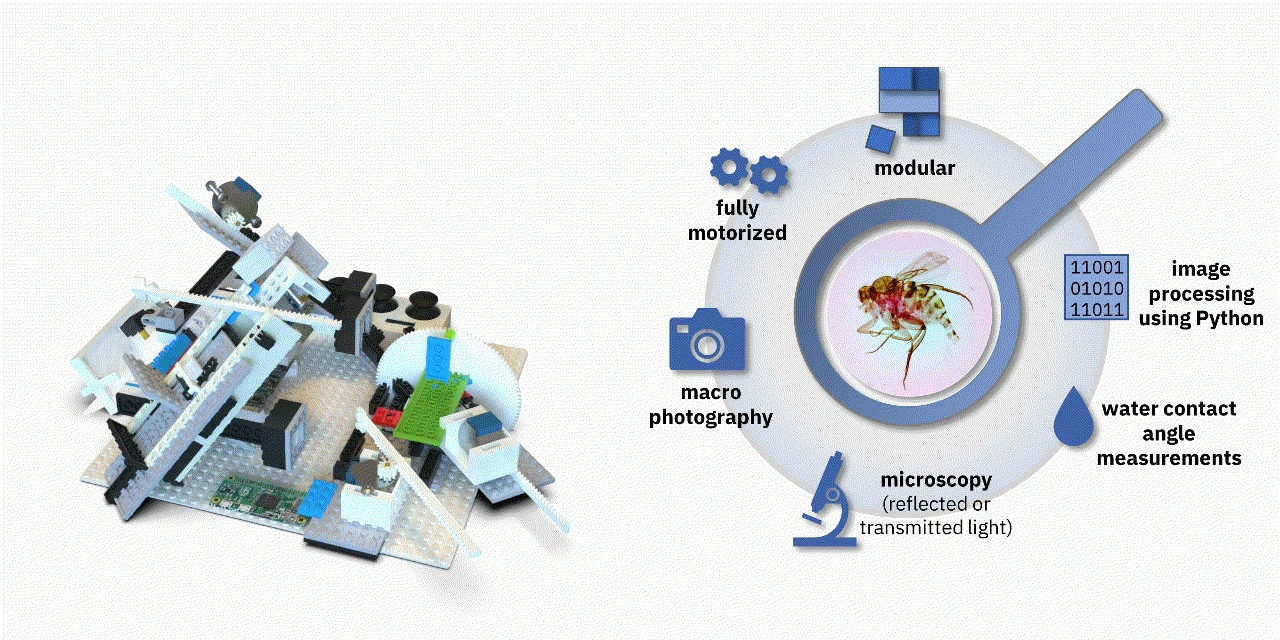
Photo credit
docs/Animation.gif
Yuksel Temiz · Apache-2.0First frame of the original animation, resized without cropping and converted to a WebP preview.
Yuksel Temiz's MicroscoPy brings camera position, sample motion, illumination, and software into one modular structure. LEGO supplies the body; custom printed actuators and electronics supply controlled movement. The guide explains how changing the distances between camera, lens, and sample changes focus and magnification.
Its documentation is unusually tangible. The main assembly manual runs to 79 pages, with separate circuit and HQ-camera instructions and a brick list. Read those before deciding whether the parts already in your drawer will fit. The source's original Raspberry Pi camera configuration and dependencies are not a promise of compatibility with every current operating-system image.
Choose this for learning how an imaging instrument comes together. Do not choose it on the assumption that an attractive sample photograph makes it a medical diagnostic device. The creator's complete microscope documentation, including heat warnings and original animations, is reproduced under Apache-2.0.
Measurement Starts with Knowing What You Have Not Measured
Bojan Jurca's ESP32 oscilloscope displays the samples an ESP32 takes in a browser. That is a useful, concrete experiment in data acquisition. The source also explains that other processes can affect the sampling interval and that the plotted samples are not necessarily an exact picture of the input signal. It is not an isolated, protected bench instrument. Keep experiments within compatible low-voltage input limits; never connect it to mains electricity.
The Ender 3 syringe-pump project by Sander Baas and Vittorio Saggiomo is a different laboratory exercise. Printer components become three pump channels. Its full assembly guide, operating instructions, and contributed pressure-fluctuation characterization are available on the build page. Mechanical motion alone does not establish precise flow performance. Read the characterization limitations and calibrate the actual setup; this is not a patient-care infusion device.
Jakub Jaszczur's weather receiver is useful for studying how local sensor data and remote MQTT messages share a screen. Outside forecasts and time depend on upstream messages. Another distinction matters: its CCS811 reports equivalent CO2 estimated from gas sensing, not a direct CO2 measurement. The sensor documentation makes that distinction explicit. A convincing dashboard should not be mistaken for a calibrated safety instrument.
Three Ways to Make Electronics Musical
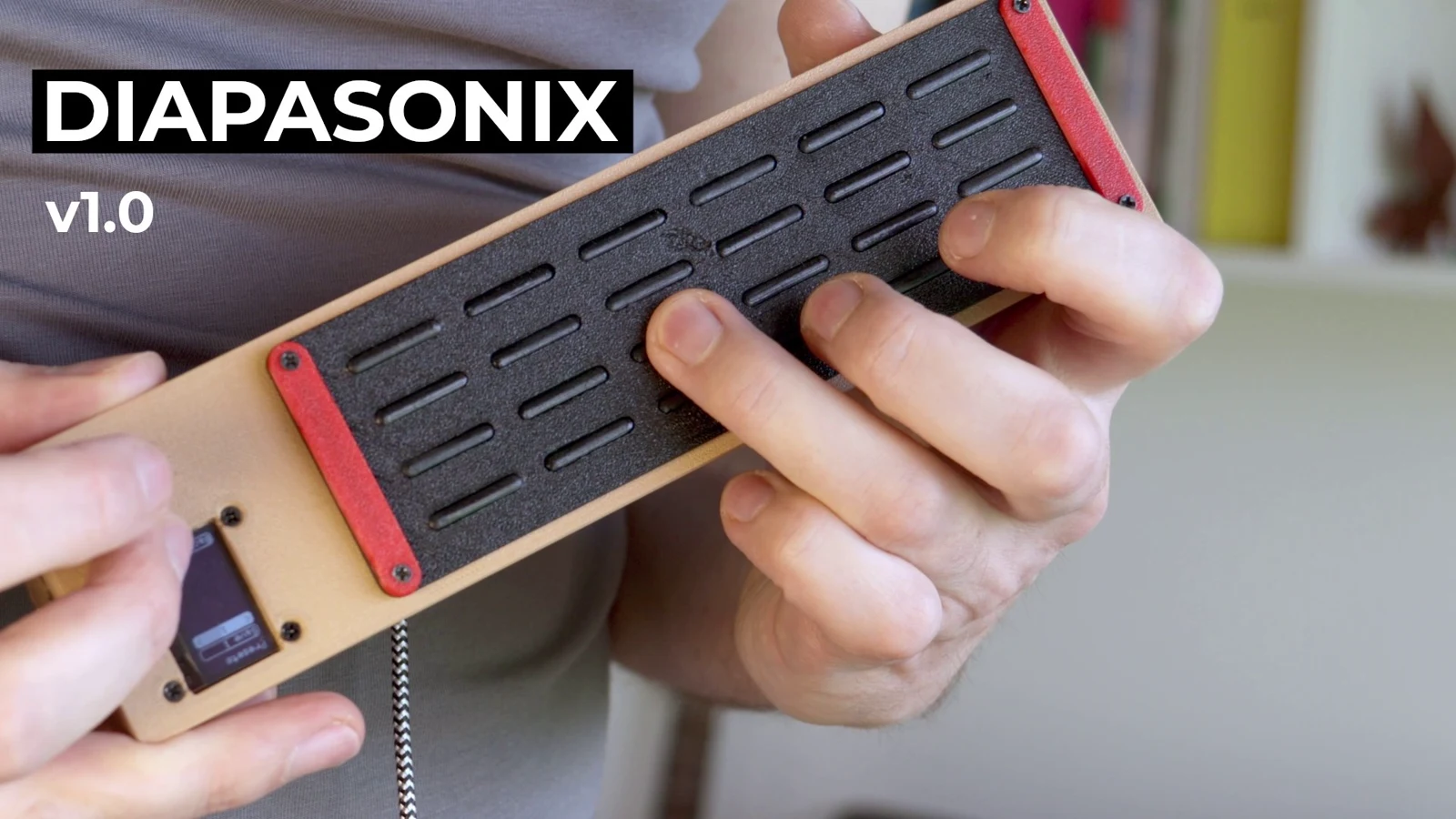
Photo credit
The music projects differ more than their microcontrollers suggest.
Brian Whitman's Alles is a distributed synthesizer. Build a speaker, configure its network, then send voices to individual units or groups. The full republication includes illustrated speaker assembly, flashing, and a substantial Python tutorial. Its fixed playback latency is a design choice for synchronization, not a defect hidden in small print. Start with one unit or a software client before planning a roomful of speakers.
Turi Scandurra's Diapasonix puts capacitive touch points into a guitar-like fretboard. Its Pico 2-based design includes synthesis and effects, with strumming and tapping modes. There is a schematic, parts list, and compilation guide, but the creator explicitly says there is no step-by-step assembly manual yet. That makes it an advanced prototype to study or adapt, not a beginner kit.
Nick Culbertson's MiniTeensy offers both a small LCD-and-encoder configuration and a fuller control panel. The wiring tables and v1.1 pin changes deserve attention before soldering. Its documented current audio route is USB; the standalone options require additional work. Pick this for physical synth controls rather than assuming every configuration is a self-contained speaker instrument.
Interesting Interfaces, Different Commitments
Scott Bezek's SmartKnob uses a motor and encoder to make end stops and detents configurable in software. The repository had more than 22,000 stars when imported, a substantial public-interest signal. Its documentation is equally clear that building one involves delicate surface-mount soldering and troubleshooting. Popular does not mean plug-and-play.
Chris Greening's ESP32 ePub reader is a better starting point if compatible e-paper hardware is already on your bench and you enjoy software constraints. The writeup explains parsing, pagination, storage, and sleep behavior. Limited formatting and character support are part of the documented design. The firmware's license does not license the books you load onto it.
Finally, the JPL Open Source Rover is the group-sized commitment here. The team's original estimate is at least 100 person-hours. Our full hardware guide combines sixteen reviewed chapters, including wiring, PCB assembly, mechanical subassemblies, parts lists, and an optional mast. Its separate software repository remains linked. Original budgets are historical estimates, not current purchasing quotes.
Read the Limitations Before the Shopping List
All ten build pages retain creator credits, pinned source links, license notices, and a record of republication changes. Original licensed diagrams and photographs are included; unverified third-party media remains linked at its source. No creator endorsement is implied.
For traffic, stars and forks are evidence of public interest, not search-volume measurements or a promise of visits. The practical reason to keep these guides together is simpler: readers can compare the commitments, choose a project, and reach the complete instructions without hunting through a collection of short summaries.
Which one would you build, and what would you change? Leave your ideas in the comments below.
Comments
Member comments are temporarily unavailable.
Log in to join the discussion.